
NCERT Solutions Class 12 Maths Chapter 1 – Relations and Functions
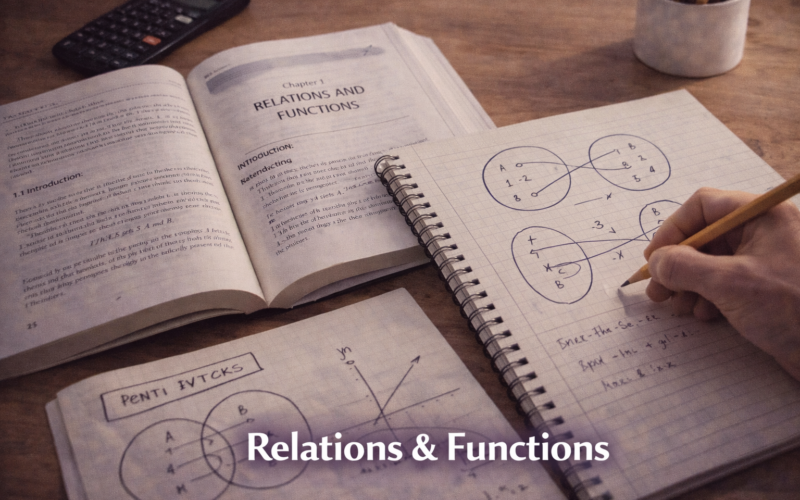
Complete NCERT Solutions for Class 12 Maths Chapter 1 – Relations and Functions. This chapter covers types of relations, types of functions, composition of functions, and invertible functions.
Chapter Overview
| Topic | Weightage in Board |
|---|---|
| Types of Relations | 4-6 marks |
| Types of Functions | 4-6 marks |
| Composition of Functions | 4 marks |
| Invertible Functions | 4 marks |
| Total Chapter Weightage | 8-10 marks |
Key Concepts
1. Types of Relations
A relation R on set A is:
- Reflexive: (a, a) ∈ R for all a ∈ A
- Symmetric: If (a, b) ∈ R, then (b, a) ∈ R
- Transitive: If (a, b) ∈ R and (b, c) ∈ R, then (a, c) ∈ R
- Equivalence: Reflexive + Symmetric + Transitive
2. Types of Functions
- One-One (Injective): f(a) = f(b) ⟹ a = b
- Onto (Surjective): Range of f = Codomain
- Bijective: Both one-one and onto
3. Composition of Functions
If f: A → B and g: B → C, then gof: A → C where (gof)(x) = g(f(x))
4. Invertible Functions
A function f is invertible if it is bijective. If f: A → B is bijective, then f⁻¹: B → A exists such that f⁻¹(f(x)) = x
Exercise 1.1 Solutions
Question 1
Determine whether each of the following relations are reflexive, symmetric and transitive:
(i) Relation R in the set A = {1, 2, 3, …, 13, 14} defined as R = {(x, y) : 3x – y = 0}
R = {(1,3), (2,6), (3,9), (4,12)}
Reflexive: (1,1) ∉ R. So R is not reflexive.
Symmetric: (1,3) ∈ R but (3,1) ∉ R. So R is not symmetric.
Transitive: (1,3) ∈ R, (3,9) ∈ R but (1,9) ∉ R. So R is not transitive.
Question 2
Show that the relation R in the set R of real numbers, defined as R = {(a, b) : a ≤ b²} is neither reflexive nor symmetric nor transitive.
Not Reflexive: For a = 1/2, we need 1/2 ≤ (1/2)² = 1/4, which is false. So (1/2, 1/2) ∉ R.
Not Symmetric: (1, 4) ∈ R since 1 ≤ 16, but (4, 1) ∉ R since 4 ≤ 1 is false.
Not Transitive: (3, 2) ∈ R (3 ≤ 4) and (2, 1.5) ∈ R (2 ≤ 2.25), but (3, 1.5) ∉ R since 3 ≤ 2.25 is false.
Exercise 1.2 Solutions
Question 1
Show that the function f : R → R defined by f(x) = 1/x is one-one and onto.
Note: f is defined on R* (non-zero reals)
One-One: Let f(x₁) = f(x₂)
⟹ 1/x₁ = 1/x₂
⟹ x₁ = x₂
Hence f is one-one.
Onto: For any y ∈ R*, let x = 1/y
Then f(x) = f(1/y) = 1/(1/y) = y
Hence f is onto.
Therefore, f is bijective.
Important Formulas
| Concept | Formula/Definition |
|---|---|
| Composition | (gof)(x) = g(f(x)) |
| Inverse | f⁻¹(y) = x where f(x) = y |
| Identity Function | I(x) = x for all x |
| Constant Function | f(x) = c for all x |
Important Tips for Board Exam
- Always check all three properties (R, S, T) separately for relations
- For proving one-one: Start with f(x₁) = f(x₂) and prove x₁ = x₂
- For proving onto: Take arbitrary element in codomain and find pre-image
- Draw diagrams for better understanding
- Practice previous year questions from this chapter
Additional Practice Questions
Short Answer Questions (2 marks each):
- Define the key terms introduced in this chapter with examples.
- Explain the main concept discussed in this chapter in your own words.
- List three real-world applications of the concepts learned.
- What are the prerequisites needed to understand this chapter?
Long Answer Questions (5 marks each):
- Explain the step-by-step process with a detailed example different from the textbook.
- Compare and contrast the different methods or concepts presented in this chapter.
- How do the concepts in this chapter connect to topics in other subjects?
Common Mistakes to Avoid
Students often make these errors while solving problems from this chapter:
- Conceptual Errors: Not understanding the fundamental principles before attempting problems. Always read the theory section carefully and ensure you understand WHY a formula or method works, not just HOW to apply it.
- Calculation Mistakes: Rushing through arithmetic operations. Double-check your calculations, especially when dealing with fractions, decimals, or negative numbers.
- Incomplete Answers: Not showing all steps in board exams. Remember that examiners award marks for each step, so write complete solutions even if the final answer is correct.
- Unit Errors: Forgetting to include or convert units. Always mention units in your final answer and ensure consistency throughout the solution.
- Misreading Questions: Not reading the question carefully. Underline key words and ensure you understand what is being asked before starting.
Tips for Board Exam Preparation
Follow these strategies to score maximum marks from this chapter:
- Master the NCERT: Board exam questions are primarily based on NCERT textbooks. Solve all in-text questions, examples, and exercise problems at least twice.
- Create Formula Sheets: Maintain a separate notebook with all important formulas, definitions, and diagrams from this chapter for quick revision.
- Practice Previous Year Questions: Solve at least 5 years of board exam questions from this chapter. This helps you understand the exam pattern and frequently asked topics.
- Time Management: Practice solving problems within a time limit. Allocate approximately 1 mark per minute as a general guideline.
- Diagram Practice: If this chapter involves diagrams, practice drawing neat, labeled diagrams. Many students lose marks due to poorly drawn or unlabeled diagrams.
Chapter Summary and Quick Revision Notes
Here is a consolidated summary of the key points from this chapter:
- This chapter builds upon foundational concepts and introduces new methods for problem-solving.
- Understanding the core principles is essential before memorizing formulas.
- Regular practice with a variety of problems helps develop problem-solving skills.
- Connect concepts to real-life situations for better retention and understanding.
- Review this chapter periodically to maintain strong fundamentals.
Frequently Asked Questions (FAQs)
Q: How important is this chapter for board exams?
A: This chapter typically carries 4-8 marks in board examinations. Questions can appear in both objective (MCQ) and subjective sections. Focus on understanding concepts thoroughly as questions often test application rather than mere recall.
Q: How much time should I dedicate to this chapter?
A: We recommend spending 2-3 hours for initial learning, followed by 1-2 hours of practice problems. During revision, allocate 30-45 minutes for a quick review of all concepts and formulas.
Q: Are there any online resources for additional practice?
A: Yes, you can find additional practice problems on educational platforms like Khan Academy, BYJU’S, and Vedantu. However, always prioritize NCERT solutions as they align directly with the board exam pattern.
Q: How can I remember the formulas from this chapter?
A: Create mnemonics or memory tricks, practice writing formulas daily, and most importantly, understand the derivation of each formula. When you understand how a formula is derived, you can recreate it even if you forget.
Related Topics to Explore
After mastering this chapter, consider exploring these related topics to deepen your understanding:
- Advanced problems from reference books like RD Sharma, RS Aggarwal, or HC Verma
- Competitive exam questions (JEE/NEET) based on this chapter for higher-level practice
- Video lectures on YouTube channels like Physics Wallah, Unacademy, or NPTEL
- Interactive simulations and virtual labs related to this topic
Self-Assessment Checklist
Before moving to the next chapter, ensure you can confidently answer “Yes” to these questions:
- I can define all key terms and concepts from this chapter
- I can solve all NCERT exercise problems without referring to solutions
- I understand the real-world applications of these concepts
- I can explain these concepts to someone else in simple terms
- I have practiced previous year board questions from this chapter
- I know the common mistakes and how to avoid them
