
Physics Practical Experiments Class 12 – Complete Lab Manual with Observations
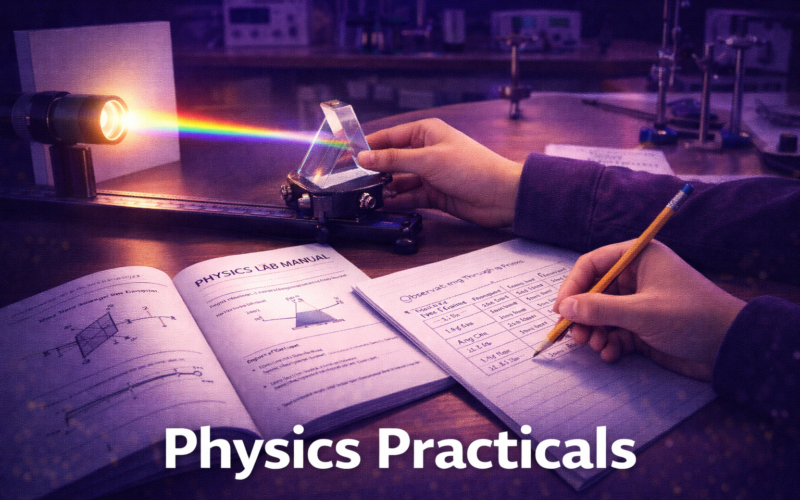
Complete Physics practical guide for Class 12 CBSE board exams. Includes procedure, observations, calculations, precautions, and viva questions for all experiments.
List of Experiments (CBSE Class 12)
| S.No | Experiment | Marks |
|---|---|---|
| 1 | Resistance using Metre Bridge | 4 |
| 2 | Resistance using Ohms Law | 4 |
| 3 | Potentiometer – Internal Resistance | 4 |
| 4 | Potentiometer – EMF Comparison | 4 |
| 5 | Galvanometer – Figure of Merit | 4 |
| 6 | Focal Length of Convex Lens | 4 |
| 7 | Focal Length of Concave Mirror | 4 |
| 8 | Refractive Index of Glass Slab | 4 |
| 9 | Angle of Minimum Deviation – Prism | 4 |
| 10 | Characteristic Curves of p-n Junction Diode | 4 |
Experiment 1: Metre Bridge – Finding Unknown Resistance
Aim
To find the resistance of a given wire using a metre bridge and hence determine its specific resistance.
Apparatus
Metre bridge, resistance box, galvanometer, jockey, one-way key, connecting wires, unknown resistance wire.
Circuit Diagram
[Standard metre bridge circuit with resistance box R in left gap and unknown resistance X in right gap]
Theory
At balance point:
X/R = (100-l)/l
Where l = balance length from left end
Specific resistance: ρ = (πd²X)/(4L)
Procedure
- Set up the circuit as shown in the diagram
- Take out a suitable resistance R from the resistance box
- Touch the jockey at different points to find null point
- Note the balance length l
- Repeat for different values of R
- Measure length L and diameter d of wire
Observation Table
| S.No | R (Ω) | l (cm) | 100-l (cm) | X = R(100-l)/l (Ω) |
|---|---|---|---|---|
| 1 | 2 | 40 | 60 | 3.0 |
| 2 | 3 | 50 | 50 | 3.0 |
| 3 | 4 | 57 | 43 | 3.02 |
Mean X = 3.01 Ω
Precautions
- Clean all connections with sandpaper
- Do not slide jockey, just touch gently
- Null point should be between 30-70 cm
- Use high resistance box for initial trials
Viva Questions
- Q: What is the principle of metre bridge?
A: It works on the principle of Wheatstone bridge. - Q: Why should null point be between 30-70 cm?
A: For better sensitivity and accuracy of measurements.
Experiment 2: Ohms Law Verification
Aim
To determine the resistance of a given wire by plotting a graph between voltage and current.
Theory
V = IR (Ohms Law)
Slope of V-I graph = Resistance R
Observation Table
| S.No | V (Volts) | I (Amperes) | R = V/I (Ω) |
|---|---|---|---|
| 1 | 0.5 | 0.10 | 5.0 |
| 2 | 1.0 | 0.20 | 5.0 |
| 3 | 1.5 | 0.30 | 5.0 |
| 4 | 2.0 | 0.40 | 5.0 |
| 5 | 2.5 | 0.50 | 5.0 |
Graph
Plot V on Y-axis and I on X-axis. The graph should be a straight line passing through origin.
Experiment 3: Potentiometer – Internal Resistance of Cell
Aim
To determine the internal resistance of a given primary cell using a potentiometer.
Theory
r = R(l₁ – l₂)/l₂
Where: l₁ = balancing length without resistance
l₂ = balancing length with resistance R in circuit
Result Format
Internal resistance of the given cell = ___ Ω
Experiment 4: Convex Lens – Focal Length by u-v Method
Aim
To find the focal length of a convex lens by plotting graphs between u and v or 1/u and 1/v.
Theory
Lens formula: 1/v – 1/u = 1/f
For 1/v vs 1/u graph: Both intercepts give 1/f
Observation Table
| S.No | u (cm) | v (cm) | 1/u (cm⁻¹) | 1/v (cm⁻¹) |
|---|---|---|---|---|
| 1 | -25 | 50 | -0.04 | 0.02 |
| 2 | -30 | 37.5 | -0.033 | 0.027 |
| 3 | -35 | 33.3 | -0.028 | 0.03 |
| 4 | -40 | 30.8 | -0.025 | 0.032 |
Experiment 5: p-n Junction Diode Characteristics
Aim
To draw the I-V characteristic curves of a p-n junction diode in forward and reverse bias.
Key Observations
- Forward bias: Current flows after threshold voltage (~0.7V for Si, ~0.3V for Ge)
- Reverse bias: Very small leakage current flows
- Knee voltage: Voltage at which current starts increasing rapidly
Graph
Forward characteristic: Exponential rise after knee voltage
Reverse characteristic: Almost flat line with small reverse saturation current
General Precautions for All Experiments
- Check all connections before switching on
- Never exceed the range of meters
- Remove parallax error while taking readings
- Take at least 5-6 readings for accuracy
- Keep apparatus away from magnetic materials
- Handle optical instruments carefully
Practical Exam Tips
- Read the procedure before starting
- Draw neat circuit/ray diagrams
- Take readings carefully with proper units
- Show calculations step by step
- Write result with proper significant figures
- Prepare common viva questions
