
Effective Study Techniques for Engineering Students: Master Your Learning
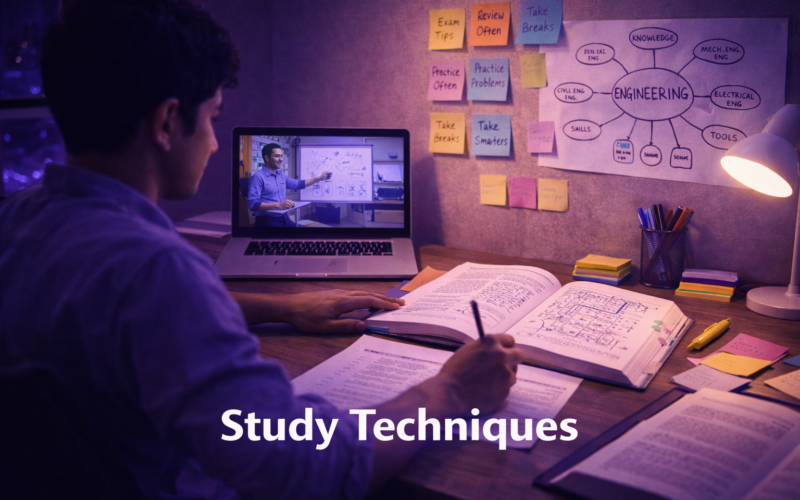
Introduction
Engineering education demands not just hard work, but smart work. With the increasing complexity of concepts from mathematics to circuit design, mastering effective study techniques is crucial for success. This guide explores proven methods that help engineering students understand complex topics, retain information longer, and excel in exams while maintaining work-life balance.
Understanding Your Learning Style
Visual Learners
If you are a visual learner, you benefit from diagrams, flowcharts, and graphical representations. For engineering subjects like circuit analysis or thermodynamics, creating circuit diagrams, drawing free body diagrams, and using color-coded notes can significantly enhance understanding and retention. Tools like draw.io and Lucidchart can help create professional diagrams.
Auditory Learners
Auditory learners grasp concepts better through discussions and explanations. Joining study groups, explaining concepts to peers, and listening to lecture recordings multiple times can be beneficial. Recording yourself explaining a concept and listening back is a powerful technique that reveals gaps in understanding.
Kinesthetic Learners
If you learn by doing, hands-on problem-solving is your strength. Engineering is ideal for kinesthetic learners because you can build circuits, write code, and solve problems physically. Spend time in labs, work through numerical problems step-by-step, and create prototypes to reinforce learning.
Active Learning Strategies
The Feynman Technique
This technique involves explaining concepts in simple language as if teaching a child. Write down what you know about a topic, identify gaps, revisit source material, and refine your explanation. This method forces deep understanding rather than surface memorization.
Problem-Based Learning
Engineering problems are the best teachers. Instead of passively reading textbooks, start with problems and work backward to understand necessary concepts. This approach mirrors real engineering practice where problems drive learning and innovation.
Spaced Repetition
The spacing effect shows that distributed practice leads to better long-term retention. Use flashcard apps like Anki to review concepts at optimal intervals. Study the same material briefly multiple times over days and weeks, rather than cramming intensively before exams.
Study Environment and Time Management
Creating the Ideal Study Space
Your environment significantly impacts learning efficiency. Choose a quiet, well-lit space with minimal distractions. Remove your phone or use blocking apps. Have all necessary materials nearby. Some students benefit from background noise, while others need complete silence. Experiment to find your optimal setting.
The Pomodoro Technique
Study for 25 minutes with full focus, take a 5-minute break, then repeat. After four cycles, take a longer 15-30 minute break. This technique combats mental fatigue and maintains concentration. It’s particularly effective for problem-solving where sustained focus is essential.
Strategic Time Blocking
Plan your week by assigning specific subjects to specific time blocks. Study difficult subjects when your energy is highest. Group related topics together to build momentum and connections. Leave buffer time for clarification and deeper exploration of challenging concepts.
Subject-Specific Strategies
Mathematics and Theoretical Subjects
For mathematics, focus on understanding the “why” behind formulas, not just memorizing them. Work through derivations step-by-step, understand assumptions, and see how different concepts connect. Practice problems of increasing difficulty, and always attempt problems before looking at solutions.
Laboratory and Practical Skills
Prepare lab reports with the same rigor as research papers. Document observations, analyze results critically, and connect theory to practice. Repeat experiments mentally before performing them to understand expected outcomes and procedures.
Programming and Code-Based Courses
The only way to learn programming is by writing code. Practice daily, start with small problems, use version control, and review others’ code. Debug your own code methodically, and understand error messages as learning opportunities rather than frustrations.
Advanced Learning Techniques
Mind Mapping and Concept Mapping
Create visual maps showing relationships between concepts. Start with a central idea and branch out with related concepts, formulas, and applications. This technique is particularly useful for subjects with many interconnected topics like thermodynamics or electromagnetics.
The Cornell Note-Taking System
Divide your page into three sections: notes, cues, and summary. During lectures, write notes on the right side. During review, write questions or cues on the left side that your notes answer. At the bottom, write a summary of the page. This system promotes active review and better organization.
Teaching Others
Explaining concepts to classmates or online communities forces you to organize thoughts coherently and identify knowledge gaps. Peer teaching is one of the most effective learning methods because it engages multiple cognitive processes simultaneously.
Exam Preparation Strategy
Months Before the Exam
Start reviewing early with spaced repetition. Understand the exam pattern, weightage, and question types. Create a study schedule that covers topics progressively rather than leaving everything for last-minute cramming.
Weeks Before
Complete all practice problems and previous year papers. Time yourself to simulate exam conditions. Identify weak areas and focus intensively on them. Review formulas, derivations, and key concepts regularly.
Days Before
Don’t introduce new material. Review your summaries and flashcards. Get adequate sleep to consolidate learning. Confidence and mental preparation are as important as content knowledge.
Avoiding Common Pitfalls
Passive Reading
Simply reading textbooks without active engagement is ineffective. Always have pen and paper ready, write summaries, solve problems, and ask questions while reading.
Over-Reliance on Rote Learning
Engineering requires understanding, not memorization. Memorize key formulas and procedures, but always understand their derivation and application.
Isolation
Study groups, discussion forums, and peer interaction are invaluable. Different perspectives and explanations can clarify confusing topics that solo study might not resolve.
Conclusion
Engineering education is challenging but manageable with the right strategies. Identify your learning style, use active learning techniques, maintain a consistent study schedule, and engage with the material deeply. Remember that effective studying is a skill that improves with practice. Experiment with different techniques, measure their effectiveness through exam performance, and refine your approach continuously. Success in engineering comes not from luck or innate talent alone, but from strategic, sustained effort combined with smart study techniques.

Leave a Reply