
Study in Germany – Complete Guide for Indian Students
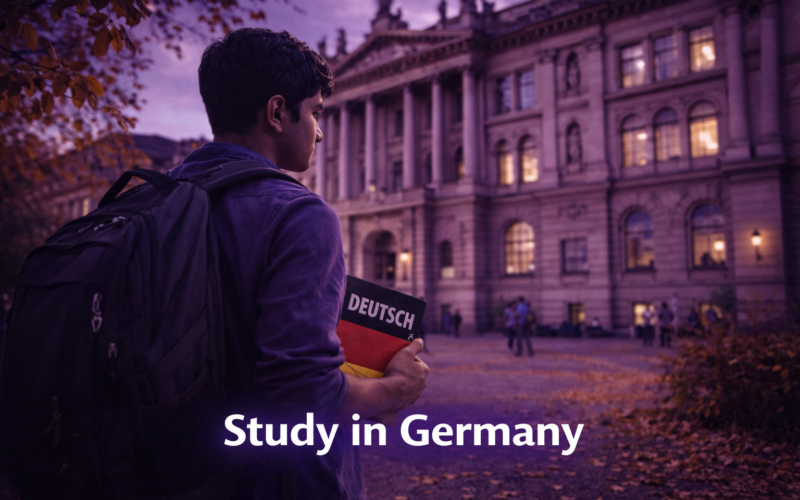
Germany has become one of the top destinations for Indian students pursuing higher education abroad. With world-class universities, affordable education, and excellent career opportunities, studying in Germany can be a life-changing experience. This comprehensive guide covers everything you need to know.
Why Study in Germany?
Key Advantages:
- Free or Low Tuition: Public universities charge minimal fees (€150-350/semester)
- World-Class Education: Home to TU9 universities and excellent research facilities
- Work Opportunities: 18-month post-study work visa
- Strong Economy: Europe’s largest economy with many job opportunities
- Central Location: Easy travel to other European countries
- Safe Environment: Low crime rate and welcoming culture
Types of Programs
Bachelor’s Programs:
- Duration: 3-4 years
- Most programs in German
- Some English-taught programs available
- Requirement: 12th pass with good grades
Master’s Programs:
- Duration: 1.5-2 years
- Many English-taught programs
- Requirement: Bachelor’s degree in relevant field
- Most popular among Indian students
PhD Programs:
- Duration: 3-5 years
- Often funded with stipend
- Strong research focus
Top Universities in Germany
TU9 – Technical University Alliance:
- RWTH Aachen University
- TU Berlin
- TU Braunschweig
- TU Darmstadt
- TU Dresden
- Leibniz University Hannover
- Karlsruhe Institute of Technology (KIT)
- TU Munich
- University of Stuttgart
Other Top Universities:
- LMU Munich
- Heidelberg University
- Humboldt University Berlin
- University of Freiburg
- University of Göttingen
Admission Requirements
For Master’s Programs:
- Academic: Bachelor’s degree with minimum 60% or 6.5 CGPA
- Language: IELTS 6.0-6.5 or TOEFL 80-90 (for English programs)
- German: B2/C1 level (for German-taught programs)
- GRE: Required by some universities (especially for technical programs)
- Documents: Transcripts, CV, SOP, LORs, passport
Application Process:
- Research universities and programs (DAAD database)
- Check specific requirements for each program
- Prepare documents and get them attested
- Apply through uni-assist or directly to university
- Application deadlines: Winter (July 15), Summer (Jan 15)
Costs and Funding
Estimated Monthly Expenses:
| Expense | Amount (EUR) |
|---|---|
| Rent | €300-500 |
| Food | €150-200 |
| Health Insurance | €110 |
| Transport | €50-80 (Semester ticket) |
| Miscellaneous | €100-150 |
| Total | €750-1000/month |
Blocked Account Requirement:
- €11,208 per year (as of 2024)
- Required for student visa
- Can withdraw €934/month
- Banks: Deutsche Bank, Expatrio, Fintiba
Scholarships:
- DAAD Scholarships: Most prestigious, covers living expenses
- Deutschlandstipendium: €300/month merit-based
- Heinrich Böll Foundation: For socially engaged students
- SBW Berlin: Full scholarship for developing countries
- University-specific scholarships: Check individual universities
Student Visa Process
Documents Required:
- Valid passport (at least 6 months validity)
- University admission letter
- Blocked account proof
- Health insurance
- Academic certificates (attested)
- Language proficiency proof
- Passport-size photographs
- Visa application form
- Cover letter
Process:
- Book appointment at German Embassy/Consulate (VFS Global)
- Submit documents and biometrics
- Processing time: 4-12 weeks
- Visa fee: €75 (approximately)
German Language
Why Learn German?
- Better job opportunities
- Easier daily life
- Required for many programs
- Integration into society
Language Levels:
- A1-A2: Basic communication
- B1-B2: Independent user (often required for admission)
- C1-C2: Proficient user
Where to Learn:
- Goethe Institut (official German institute)
- Max Mueller Bhavan in India
- Online: DW Learn German, Duolingo
- University language courses in Germany
Working While Studying
Work Permissions:
- 120 full days or 240 half days per year
- Unlimited hours for university jobs
- Minimum wage: €12.41/hour (2024)
- Common jobs: HiWi (research assistant), working student, tutoring
After Graduation
Job Seeker Visa:
- 18-month residence permit to find job
- Can work part-time during this period
- Once employed, can get work permit
Career Opportunities:
- Engineering and IT sector: Very high demand
- Automotive industry: BMW, Mercedes, Volkswagen
- Research positions: Fraunhofer, Max Planck institutes
- Startups: Berlin has a thriving startup scene
Step-by-Step Timeline
| When | What to Do |
|---|---|
| 12-18 months before | Research universities, start German classes |
| 10-12 months before | Take IELTS/TOEFL, prepare documents |
| 6-8 months before | Apply to universities |
| 4-6 months before | Receive admission, open blocked account |
| 3-4 months before | Apply for visa |
| 1-2 months before | Book accommodation, flight |
Useful Resources
- DAAD: www.daad.de (Official database of programs)
- Study in Germany: www.study-in-germany.de
- Uni-assist: www.uni-assist.de (Application portal)
- Anabin: Recognition of Indian degrees
Note: Information is subject to change. Always verify current requirements from official sources before applying.
