
Engineering Mechanics Notes – Complete Study Material for First Year
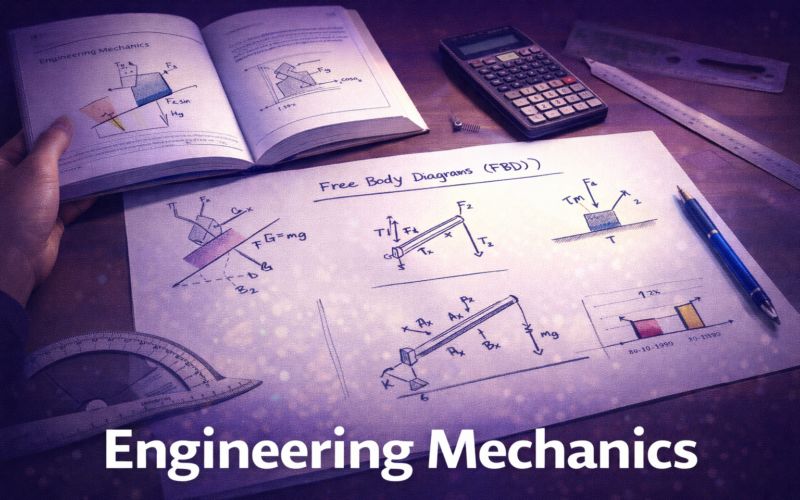
Engineering Mechanics is a fundamental subject for all engineering branches. These comprehensive notes cover Statics and Dynamics with solved examples, formulas, and important concepts for university exams.
Course Overview
| Topic | Weightage |
|---|---|
| Statics – Force Systems | 20% |
| Equilibrium | 15% |
| Friction | 15% |
| Centroid & Moment of Inertia | 20% |
| Kinematics | 15% |
| Kinetics | 15% |
Unit 1: Statics – Force Systems
1.1 Basic Concepts
- Force: An action that changes or tends to change the state of rest or motion of a body
- Types: Contact forces, Body forces, Point forces, Distributed forces
- Characteristics: Magnitude, Direction, Point of application, Line of action
1.2 Resolution of Forces
Rectangular Components:
- Fx = F cos θ (Horizontal component)
- Fy = F sin θ (Vertical component)
- F = √(Fx² + Fy²)
- θ = tan⁻¹(Fy/Fx)
1.3 Resultant of Concurrent Forces
Parallelogram Law:
R = √(P² + Q² + 2PQ cos θ)
tan α = Q sin θ / (P + Q cos θ)
1.4 Moment of a Force
Moment = Force × Perpendicular distance
M = F × d (Unit: N-m)
Varignons Theorem: Moment of resultant = Sum of moments of components
1.5 Couple
- Two equal, opposite, parallel forces
- Moment of couple = F × d (arm of couple)
- A couple can only be balanced by another couple
Unit 2: Equilibrium
2.1 Conditions of Equilibrium
For Coplanar Forces:
- ΣFx = 0 (Sum of horizontal forces = 0)
- ΣFy = 0 (Sum of vertical forces = 0)
- ΣM = 0 (Sum of moments about any point = 0)
2.2 Types of Supports
| Support | Reactions | Unknowns |
|---|---|---|
| Roller | Normal only | 1 |
| Hinged/Pinned | Horizontal + Vertical | 2 |
| Fixed | H + V + Moment | 3 |
2.3 Free Body Diagram (FBD)
Steps to draw FBD:
- Isolate the body from surroundings
- Show all external forces
- Replace supports with their reactions
- Include weight acting at center of gravity
Unit 3: Friction
3.1 Laws of Friction
- Friction acts opposite to direction of motion/tendency
- Friction is proportional to normal reaction: f = μN
- Friction is independent of area of contact
- Friction depends on nature of surfaces
3.2 Types of Friction
- Static friction: fs ≤ μsN (limiting friction = μsN)
- Kinetic friction: fk = μkN (μk < μs)
- Angle of friction: tan φ = μ
- Angle of repose: α = φ (for inclined plane)
3.3 Applications
- Ladder problems
- Wedge friction
- Belt and pulley friction: T1/T2 = e^(μθ)
- Screw jack: P = W tan(α ± φ)
Unit 4: Centroid and Moment of Inertia
4.1 Centroid
For composite areas:
x̄ = ΣAixi / ΣAi
ȳ = ΣAiyi / ΣAi
4.2 Moment of Inertia (Second Moment of Area)
| Shape | Ixx (about centroid) | Iyy (about centroid) |
|---|---|---|
| Rectangle (b×d) | bd³/12 | db³/12 |
| Triangle (base b, height h) | bh³/36 | hb³/36 |
| Circle (radius r) | πr⁴/4 | πr⁴/4 |
| Semicircle | 0.11r⁴ | πr⁴/8 |
4.3 Parallel Axis Theorem
I = Ic + Ad²
Where: Ic = MI about centroidal axis, A = area, d = distance between axes
Unit 5: Kinematics
5.1 Rectilinear Motion
- v = u + at
- s = ut + ½at²
- v² = u² + 2as
- s = ½(u + v)t
5.2 Projectile Motion
- Range: R = u²sin2θ/g
- Max Height: H = u²sin²θ/2g
- Time of Flight: T = 2u sinθ/g
- Trajectory: y = x tanθ – gx²/2u²cos²θ
5.3 Circular Motion
- Angular velocity: ω = dθ/dt (rad/s)
- Angular acceleration: α = dω/dt (rad/s²)
- v = rω, a_t = rα, a_n = v²/r = rω²
Unit 6: Kinetics
6.1 Newtons Laws of Motion
- Second Law: F = ma
- DAlemberts Principle: F – ma = 0 (Inertia force = -ma)
6.2 Work, Energy, Power
- Work: W = F.s.cosθ (Joules)
- Kinetic Energy: KE = ½mv²
- Potential Energy: PE = mgh
- Power: P = W/t = F.v (Watts)
- Work-Energy Theorem: W = ΔKE
6.3 Impulse and Momentum
- Momentum: p = mv
- Impulse: J = FΔt = Δp
- Conservation: m1u1 + m2u2 = m1v1 + m2v2
- Coefficient of restitution: e = (v2-v1)/(u1-u2)
Important Solved Problems
Practice these types for exam:
- Finding resultant of force system
- Equilibrium of rigid bodies
- Ladder and friction problems
- Centroid of composite sections
- Moment of inertia calculations
- Projectile motion problems
- Collision and momentum problems
Engineering Mechanics: Key Topics for First-Year Exam
Statics: Forces and Equilibrium
- Types of Forces: Concurrent (acting at the same point), coplanar (in the same plane), collinear (along the same line), parallel forces
- Resolution of Forces: Any force can be resolved into horizontal (Fx = F cos θ) and vertical (Fy = F sin θ) components
- Resultant of Forces: For concurrent forces — R = √(ΣFx)2 + (ΣFy)2; direction: tan α = ΣFy/ΣFx
- Lami Theorem: For three concurrent coplanar forces in equilibrium: F1/sin α = F2/sin β = F3/sin γ, where α, β, γ are the angles opposite to respective forces
- Conditions of Equilibrium: ΣFx = 0, ΣFy = 0, ΣM = 0 (sum of moments = 0)
Moment and Couple
- Moment of a Force: M = F × d (Force × perpendicular distance from the pivot). Clockwise = negative; anticlockwise = positive (by convention)
- Varignon Theorem: The moment of a resultant force about any point equals the sum of moments of its components about the same point
- Couple: Two equal, opposite, parallel forces separated by a distance d. Moment of couple = F × d. A couple only produces rotation, not translation.
Centroid and Centre of Gravity
- Centroid: Geometric centre of a plane figure. For simple shapes: rectangle (centre), triangle (1/3 from base), semicircle (4r/3π from diameter)
- Composite Areas: x̄ = (A1x1 + A2x2 + …)/( A1 + A2 + …); ȳ similarly
- For areas with holes: subtract the hole area and its moment
Friction
- Laws of Dry Friction (Coulomb): F = μN (friction force = coefficient of friction × normal reaction); friction is independent of contact area; static friction is greater than kinetic friction
- Angle of Friction: φ = tan-1(μs)
- Angle of Repose: Maximum angle at which a body rests on an inclined plane without sliding = angle of friction
- Common applications: wedge, screw jack, belt drive, ladder
Kinematics (Dynamics)
- Equations of motion (uniform acceleration): v = u + at; s = ut + 0.5at2; v2 = u2 + 2as
- Projectile motion: Horizontal: x = v0cosθ × t; Vertical: y = v0sinθ × t – 0.5gt2. Range = v02 sin 2θ / g; Max height = v02 sin2θ / 2g
- Curvilinear motion: Normal acceleration an = v2/r; Tangential acceleration at = dv/dt
Common University Exam Questions in Engineering Mechanics
- Find the resultant of a system of concurrent coplanar forces (magnitude and direction)
- A body rests on an inclined plane — find the minimum force required to prevent sliding (friction problems)
- Find the centroid of a composite area (T-section, I-section, L-section)
- Determine forces in the members of a truss using the method of joints or method of sections
- A particle is projected at 30° with initial velocity 40 m/s — find range, maximum height, time of flight
