
Campus Placement Guide: From Resume Building to Job Offer
Introduction
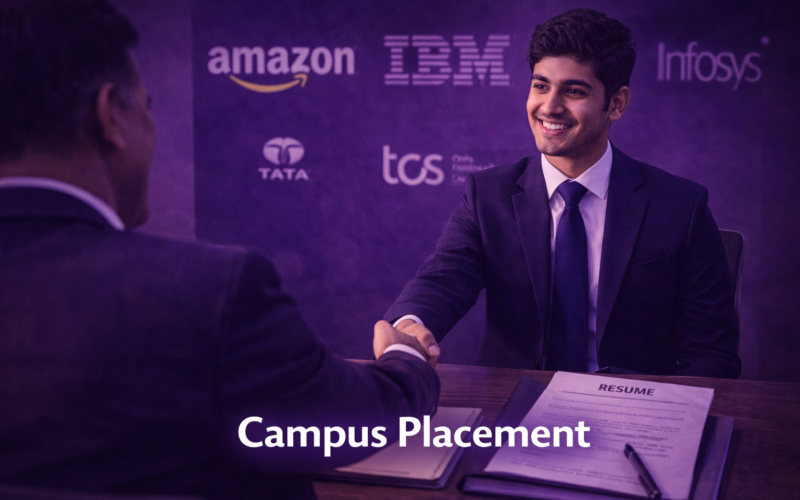
Campus placements represent one of the most critical phases in an engineering student’s academic journey. The opportunity to secure a job before graduation can set the trajectory for your entire career. This comprehensive guide covers everything you need to know about preparing for and succeeding in campus placements.
Understanding the Campus Placement Process
How Campus Placements Work
Companies visit colleges during the placement season to recruit fresh talent. The process typically includes pre-placement talks, written tests, group discussions, technical interviews, and HR interviews. Understanding each stage helps you prepare systematically.
Types of Placements
Campus placements fall into several categories: on-campus (companies visit your college), off-campus (you apply directly), pool campus (multiple colleges share a placement drive), and internship conversions. Each pathway has its own preparation requirements.
Building a Strong Resume
Resume Structure
Keep your resume to one page for freshers. Use a clean format with sections: contact information, education, skills, projects, internships, achievements, and extracurriculars. Use bullet points, action verbs, and quantify achievements wherever possible.
Highlighting Projects
Projects demonstrate practical application of knowledge. Include 2-3 significant projects with clear descriptions of the problem, your approach, technologies used, and results achieved. GitHub links add credibility.
Aptitude Test Preparation
Quantitative Aptitude
Practice arithmetic, algebra, geometry, probability, and data interpretation. Speed and accuracy are both important. Master shortcuts and mental math techniques.
Logical Reasoning
Develop skills in puzzles, seating arrangements, blood relations, coding-decoding, and syllogisms. Regular practice improves pattern recognition.
Verbal Ability
Focus on reading comprehension, grammar, vocabulary, and sentence completion. Read regularly to improve comprehension speed.
Technical Interview Preparation
Data Structures and Algorithms
Master fundamental data structures: arrays, linked lists, stacks, queues, trees, graphs, and hash tables. Practice on LeetCode, HackerRank, or GeeksforGeeks regularly.
Programming Language Proficiency
Be deeply familiar with at least one programming language. Understand language-specific features and best practices. For most IT companies, proficiency in C/C++, Java, or Python is expected.
Core Subject Knowledge
Review fundamentals of DBMS, operating systems, computer networks, and software engineering. Companies test these subjects to assess your foundational understanding.
Group Discussion Skills
GD Strategies
Listen actively and build on others’ points. Maintain eye contact with all participants. Support your arguments with examples and data when possible.
Handling Disagreements
Disagree respectfully without making it personal. Acknowledge valid points from others before presenting counterarguments.
HR Interview Preparation
Common HR Questions
Prepare for classics like “Tell me about yourself,” “Why this company?”, “Your strengths and weaknesses,” and “Why should we hire you?” Prepare authentic, thoughtful responses.
Company Research
Research the company thoroughly: products, services, recent news, and company culture. Understand the role you’re applying for and how your skills align.
Building Your Profile
Internships
Internships provide practical experience and industry exposure. They often lead to pre-placement offers. Seek internships in your pre-final year.
Certifications
Industry certifications add credibility. Cloud certifications (AWS, Azure), programming certifications, and domain-specific courses demonstrate initiative.
Conclusion
Campus placements require months of dedicated preparation across multiple dimensions. Start early, be consistent, and maintain a positive attitude. Remember that placements are just the beginning of your career journey.
Campus Placement: Complete Preparation Strategy
Campus placements are a critical milestone in every engineering and MBA student career. A structured preparation plan starting at least 6 months before the season gives you a significant edge.
Phase 1: Resume and Profile Building (3–6 months before)
- Keep your resume to 1 page if you have less than 2 years of experience
- Lead with a strong summary: “Final year B.Tech student in Computer Science with 2 internships, proficient in Java and Python”
- List only relevant skills — do not pad with tools you barely know
- GitHub profile matters: maintain at least 3–4 completed projects with README documentation
- LinkedIn must be complete: summary, skills, education, projects, and a professional photo
- Target a CGPA of 7.0+ — many companies filter below 6.5 or 7.0
Phase 2: Aptitude and Coding Preparation (2–3 months before)
- Quantitative Aptitude: Time and Work, Percentages, Profit and Loss, Ratios, Number Systems, Speed-Time-Distance (practice R.S. Aggarwal or IndiaBix)
- Logical Reasoning: Series, Seating Arrangement, Syllogisms, Blood Relations, Coding-Decoding
- Verbal Ability: Reading Comprehension, Synonyms/Antonyms, Sentence Correction, Error Detection
- Coding: Practice Data Structures and Algorithms on LeetCode (Easy/Medium). Target 100+ problems before the season.
- Key topics: Arrays, Strings, Linked Lists, Trees, Graphs, Dynamic Programming, Sorting
Phase 3: Technical Interview Preparation (1–2 months before)
- Core subjects: OS (process management, scheduling, memory), DBMS (SQL, normalization, transactions), Networks (OSI model, TCP/IP, HTTP), OOP (classes, inheritance, polymorphism)
- Prepare answers for: “Tell me about yourself”, “Why this company?”, “What is your biggest achievement?”
- Be ready to explain every line on your resume — especially projects
- Practice coding problems on a whiteboard or in a shared editor (like HackerRank, CoderPad)
Group Discussion Tips
- Be the first to speak if you have a point ready — it shows confidence
- Listen actively — build on others points rather than repeating ideas
- Use data and examples: “According to NASSCOM, India will need 1 million AI professionals by 2030…”
- Avoid dominating — companies evaluate both your communication AND your ability to work in teams
Day-of-Interview Checklist
- Carry 3 copies of your resume and ID proof
- Reach the venue 30 minutes early
- Dress formally — dark trousers, light formal shirt for men; formal saree/suit for women
- Switch your phone to silent mode before entering
- Prepare 2–3 thoughtful questions to ask the interviewer (shows genuine interest)
Top Recruiters Visiting Indian Engineering Colleges
TCS, Infosys, Wipro, Accenture, Cognizant, HCL, Capgemini, IBM, Deloitte, Amazon, Google, Microsoft, Flipkart, Juspay, Zoho, and Freshworks are among the most active campus recruiters. Product companies visit NITs, IITs, and top private colleges while service companies recruit broadly. Apply for pre-placement internships as a direct path to PPOs (Pre-Placement Offers).
