
GRE Complete Preparation Guide – Syllabus, Pattern, Tips & Resources
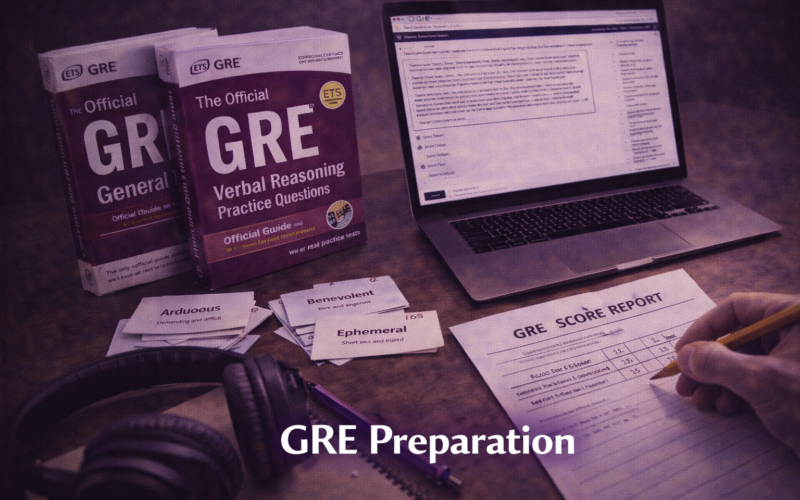
Planning to study in the USA, Canada, or Europe? The GRE (Graduate Record Examination) is your gateway to top universities worldwide. This comprehensive guide covers everything you need to know about GRE 2026.
GRE 2026 Overview
| Aspect | Details |
|---|---|
| Full Form | Graduate Record Examination |
| Conducting Body | ETS (Educational Testing Service) |
| Test Duration | 1 hour 58 minutes (shorter GRE) |
| Test Fee | $220 (approximately Rs. 18,000) |
| Score Validity | 5 years |
| Score Range | 260-340 (Verbal + Quant) |
| Test Mode | Computer-based (at home or test center) |
GRE Exam Pattern 2026
| Section | Questions | Time | Score Range |
|---|---|---|---|
| Analytical Writing | 1 Essay | 30 min | 0-6 |
| Verbal Reasoning | 27 Questions | 41 min | 130-170 |
| Quantitative Reasoning | 27 Questions | 47 min | 130-170 |
Section-wise Preparation Strategy
Verbal Reasoning (130-170)
Question Types:
- Reading Comprehension (10-12 questions)
- Text Completion (6-7 questions)
- Sentence Equivalence (5-6 questions)
Preparation Tips:
- Build Vocabulary: Learn 1000+ GRE words using flashcards
- Read Daily: The Economist, Scientific American, NY Times
- Practice RC: Focus on main idea, inference, tone questions
- Learn Root Words: Helps guess meaning of unknown words
Quantitative Reasoning (130-170)
Topics Covered:
- Arithmetic (25%)
- Algebra (25%)
- Geometry (25%)
- Data Analysis (25%)
Preparation Tips:
- Master Basics: Class 10 level math is sufficient
- Learn Shortcuts: Mental math saves time
- Practice Data Interpretation: Graphs, tables, charts
- Use Calculator Wisely: On-screen calculator available
Analytical Writing (0-6)
Task: Analyze an Argument (30 minutes)
Tips:
- Identify logical flaws in the argument
- Write 4-5 paragraphs with clear structure
- Use specific examples and reasoning
- Aim for 400-500 words
3-Month GRE Study Plan
Month 1: Foundation
- Week 1-2: Learn 500 vocabulary words, basic math concepts
- Week 3-4: Start practice questions, take diagnostic test
Month 2: Practice
- Week 5-6: Intensive vocabulary, advanced quant topics
- Week 7-8: Full-length practice tests, analyze mistakes
Month 3: Refinement
- Week 9-10: Focus on weak areas, timed practice
- Week 11-12: Mock tests, AWA practice, final revision
Best GRE Preparation Resources
Free Resources
- ETS PowerPrep: 2 free official practice tests
- Magoosh Vocabulary App: 1000+ flashcards
- GregMat YouTube: Free strategy videos
- Khan Academy: Math refresher
Paid Resources
- ETS Official Guide: Must-have book (Rs. 1500)
- Manhattan 5lb: 1800+ practice questions
- Magoosh Online: $149 for 6 months
- GregMat+: $5/month (best value)
GRE Score Requirements for Top Universities
| University | Program | Average GRE |
|---|---|---|
| MIT | MS CS | 330+ |
| Stanford | MS CS | 328+ |
| CMU | MS CS | 325+ |
| UC Berkeley | MS EE | 320+ |
| Georgia Tech | MS CS | 318+ |
| UT Austin | MS CS | 315+ |
| UIUC | MS CS | 315+ |
| Purdue | MS Engineering | 310+ |
Important Tips
- Book Early: Test slots fill up fast, book 2 months in advance
- Target Score: Aim for 320+ for top universities
- Retake Policy: Can retake after 21 days (max 5 times/year)
- Score Sending: 4 free score reports on test day
- At-Home Test: Valid option with same scoring
Understanding the Broader Context
This topic doesn’t exist in isolation – it connects to numerous aspects of education, career development, and real-world applications. Understanding these connections helps you appreciate the importance of what you’re learning and how it fits into the bigger picture.
In today’s competitive landscape, students and professionals need to develop a comprehensive understanding rather than surface-level knowledge. This article aims to provide you with that depth, covering not just the basics but also the nuances that make the difference between average and exceptional understanding.
Detailed Analysis and Insights
Let’s dive deeper into the aspects that often get overlooked but are crucial for a complete understanding:
The Foundation: Every concept we discuss here builds upon fundamental principles that have been developed and refined over decades. When you understand these foundations, you’re not just memorizing facts – you’re developing a framework for thinking that will serve you throughout your academic and professional journey.
Practical Applications: Theory without practice remains incomplete. Throughout this guide, we emphasize real-world applications because that’s where knowledge transforms into skill. Whether you’re preparing for exams or building a career, the ability to apply what you’ve learned is what sets successful individuals apart.
Current Trends: The world is constantly evolving, and staying updated with current trends is essential. We’ve incorporated the latest developments and industry insights to ensure this guide remains relevant and valuable for your goals.
Step-by-Step Approach
For best results, we recommend following this structured approach:
- Read Thoroughly: Go through all sections carefully, taking notes on key points
- Reflect and Connect: Think about how each concept connects to what you already know
- Practice Actively: Apply what you’ve learned through exercises, projects, or real-world scenarios
- Review Regularly: Revisit this material periodically to reinforce your understanding
- Seek Clarification: If something isn’t clear, use additional resources or ask experts
Expert Tips and Recommendations
Based on extensive experience and feedback from successful students and professionals, here are our top recommendations:
- Consistency Over Intensity: Regular, focused study sessions are more effective than occasional marathon sessions. Aim for 1-2 hours of focused learning daily rather than 8-hour sessions once a week.
- Active Recall: Instead of passive reading, test yourself frequently. Close the book and try to recall what you’ve learned. This strengthens memory retention significantly.
- Teach Others: One of the most effective ways to solidify your understanding is to explain concepts to others. If you can teach it clearly, you truly understand it.
- Stay Updated: Subscribe to relevant newsletters, follow industry experts on social media, and regularly check for updates in your field of interest.
- Build a Network: Connect with peers, mentors, and professionals who share your interests. Learning becomes more effective and enjoyable when done in community.
Common Challenges and Solutions
Every learning journey comes with challenges. Here’s how to overcome the most common ones:
Challenge: Information Overload
Solution: Focus on fundamentals first. Master the basics before moving to advanced topics. Use the 80/20 rule – 80% of results come from 20% of the content. Identify and focus on that crucial 20%.
Challenge: Lack of Motivation
Solution: Set clear, achievable goals. Break large objectives into smaller milestones. Celebrate small wins. Connect with others who share similar goals for mutual support and accountability.
Challenge: Time Constraints
Solution: Prioritize ruthlessly. Use time-boxing techniques. Eliminate distractions during study sessions. Make use of small pockets of time throughout the day for review and practice.
Future Outlook
Understanding current trends is important, but anticipating future developments gives you a competitive edge. Based on current trajectories and expert analyses, here’s what to expect:
- Increasing integration of technology in education and professional development
- Growing emphasis on practical skills alongside theoretical knowledge
- More opportunities for online learning and remote skill development
- Greater demand for interdisciplinary knowledge and adaptability
- Rising importance of soft skills alongside technical competencies
Conclusion and Next Steps
We’ve covered substantial ground in this guide, providing you with both foundational knowledge and practical insights. Remember that learning is a journey, not a destination. The concepts discussed here are stepping stones to greater understanding and achievement.
Your next steps should include:
- Reviewing and implementing the strategies discussed
- Creating a personal action plan based on your specific goals
- Seeking additional resources for areas where you need more depth
- Connecting with others who can support your learning journey
- Regularly assessing your progress and adjusting your approach as needed

Leave a Reply