
Campus Placement Interview Guide – HR, Technical & GD Tips
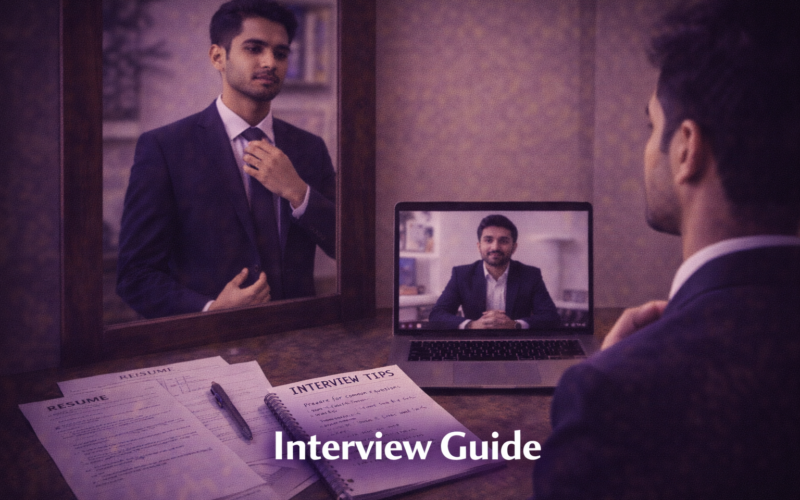
Campus placements are the gateway to your engineering career. This comprehensive guide covers everything from resume building to cracking technical interviews and HR rounds.
Campus Placement Process Overview
- Resume Shortlisting – Based on CGPA, skills, projects
- Online/Written Test – Aptitude, Technical, Coding
- Group Discussion (GD) – Communication, teamwork
- Technical Interview – Core subjects, coding, projects
- HR Interview – Personality, culture fit
Building a Winning Resume
Essential Sections
- Contact Information: Email, Phone, LinkedIn, GitHub
- Education: College, CGPA, 10th & 12th marks
- Skills: Programming languages, tools, frameworks
- Projects: 2-3 significant projects with descriptions
- Internships: Company, role, achievements
- Achievements: Competitions, certifications, awards
- Keep it to 1 page for freshers
- Use action verbs: Developed, Implemented, Designed
- Quantify achievements: “Improved performance by 30%”
- Tailor for each company
- No spelling/grammar errors
Aptitude Test Preparation
Topics to Cover
| Section | Topics |
|---|---|
| Quantitative | Percentages, Profit/Loss, Time & Work, Probability, Permutations |
| Logical | Puzzles, Seating Arrangement, Blood Relations, Coding-Decoding |
| Verbal | Reading Comprehension, Sentence Correction, Para Jumbles |
Recommended Resources
- RS Aggarwal – Quantitative Aptitude
- Arun Sharma – Logical Reasoning
- IndiaBix, PrepInsta – Online practice
Technical Interview Preparation
For CS/IT Students
- Data Structures: Arrays, Linked Lists, Stacks, Queues, Trees, Graphs
- Algorithms: Sorting, Searching, Dynamic Programming, Greedy
- DBMS: SQL queries, Normalization, Transactions
- OS: Process, Threads, Memory Management, Scheduling
- OOPs: Inheritance, Polymorphism, Abstraction, Encapsulation
- Coding: Practice on LeetCode, HackerRank, CodeChef
For Core Branches (ECE, EE, ME)
- Focus on fundamentals of your branch
- Prepare final year project thoroughly
- Know basics of C programming
- Understand practical applications
Common Technical Questions
- Tell me about your final year project
- Difference between Process and Thread
- Explain OOPs concepts with examples
- Write code to reverse a linked list
- What is normalization in DBMS?
- Explain your favorite data structure
HR Interview Questions & Answers
1. Tell me about yourself
Format: Present → Past → Future
“I am a final year B.Tech student at XYZ College with a CGPA of 8.5. I have a strong foundation in [skills] and have worked on projects like [project]. I interned at [company] where I [achievement]. I am passionate about [area] and looking forward to starting my career at [company name].”
2. Why should we hire you?
“I bring a combination of strong technical skills, a quick learning ability, and a team-oriented mindset. My project experience in [area] directly aligns with this role. I am committed to contributing to [company] while growing professionally.”
3. What are your strengths and weaknesses?
Strength: Give a genuine strength with an example
Weakness: Share a real weakness and how you are working on it
4. Where do you see yourself in 5 years?
“I see myself as a senior developer/team lead, having gained deep expertise in [technology]. I want to contribute to impactful projects while mentoring junior team members.”
5. Why this company?
Research the company: products, culture, recent news. Show genuine interest.
Group Discussion Tips
- Do: Listen actively, build on others points, maintain eye contact
- Do: Enter early but not first, use facts and examples
- Do: Summarize if given the chance
- Dont: Interrupt, dominate, get into arguments
- Dont: Sit silently, speak just for the sake of it
Day Before Interview Checklist
- Review your resume – know every line
- Prepare 2-3 questions to ask the interviewer
- Research the company thoroughly
- Keep documents ready (resume, certificates, ID)
- Plan your outfit (formal, neat)
- Sleep well – at least 7 hours
- Reach venue 30 minutes early
More Career Resources
Explore our guides on building successful engineering careers.
Engineering Career Guide →Advanced Campus Interview Preparation Tips
Technical Interview: What to Expect
Campus technical interviews typically consist of 2–3 rounds, each 45–60 minutes. Here is what each round looks like:
- Round 1 (Online Test): MCQs on aptitude + coding problems (2–3 questions of Easy to Medium difficulty). Platforms: HackerRank, Amcat, CoCubes, or company-specific portals.
- Round 2 (Technical Interview 1): Data structures, algorithms, core CS subjects, and resume discussion. Expect live coding on a shared editor or whiteboard.
- Round 3 (Technical Interview 2): For product companies — deeper system design discussion, advanced DSA, and project deep-dive. For service companies — soft skills and technical communication.
- Final Round (HR): Salary discussion, role expectations, relocation, joining date. Behavioural questions using STAR method.
Common Technical Questions (Core CS)
- What is the difference between a stack and a queue? When would you use each?
- Explain the time complexity of binary search. What are its limitations?
- What is normalisation in DBMS? What are 1NF, 2NF, 3NF?
- What is the difference between TCP and UDP? Give use cases for each.
- What is a deadlock? What are the necessary conditions (Coffman conditions)?
- Explain virtual memory and paging.
- What is polymorphism in OOP? How is it implemented in C++/Java?
- What is the difference between process and thread?
Coding Problem Strategy
- Read the problem fully before writing code — clarify edge cases with the interviewer
- Think out loud — interviewers want to see your reasoning, not just the final solution
- Start with a brute-force approach, then optimise (show you know the trade-offs)
- Test your code with at least 2–3 examples before claiming it is correct
- Common patterns: Two pointers, sliding window, BFS/DFS, DP (memoization/tabulation), backtracking
HR Interview: STAR Method
STAR = Situation, Task, Action, Result. Use this structure for behavioural questions:
- “Tell me about a challenge you overcame”: Situation (project had tight deadline) → Task (lead the backend integration) → Action (coordinated with 3 teammates, worked extra hours) → Result (delivered on time, received appreciation from HOD)
- “Describe a time you worked in a team”: Same STAR structure with focus on collaboration
- “What is your greatest weakness?”: Be honest but frame it positively — “I used to struggle with public speaking, but I joined my college technical fest organising committee, which helped me significantly”
Questions to Ask the Interviewer
- “What does a typical onboarding look like for a fresher joining this role?”
- “What technologies does the team primarily work with?”
- “What are the biggest challenges the team is currently working on?”
- “What does career growth look like in this role over the first 2–3 years?”
